Author: LA’REI SIEMPRE®

  • When the Desire to Hurt Others Reveals the Need for Inner Healing

    When the Desire to Hurt Others Reveals the Need for Inner Healing

    LA’REI SIEMPRE® | MIND • BODY • SOUL

    Self-Improvement • Emotional Healing • Personal Growth

    When the Problem Is No Longer About Someone Else

    There comes a point in life when we must stop examining what other people are doing and begin examining what is happening within ourselves.

    Why does another person’s happiness disturb you?

    Why does their progress make you uncomfortable?

    Why does their success awaken resentment instead of inspiration?

    And perhaps the most uncomfortable question of all:

    What is happening within you that makes another person’s suffering feel like your victory?

    These are not questions designed to condemn. They are invitations to self-examination.

    Because sometimes, the desire to hurt another person reveals a deeper wound that has never been acknowledged, understood or healed.

    The Hidden Cost of Jealousy and Resentment

    Jealousy and resentment rarely announce themselves honestly.

    Sometimes, they disguise themselves as criticism, competition, gossip or the constant need to diminish another person’s achievements.

    You may find yourself comparing your life to someone else’s, questioning why they have opportunities you believe should belong to you.

    But comparison is a dangerous place to build your identity.

    Another person’s success is not evidence of your failure.

    Their happiness does not diminish your worth.

    Their progress does not mean you have been forgotten.

    And their blessings do not prevent you from creating a meaningful life of your own.

    When your attention becomes consumed by what another person possesses, you risk neglecting the very life you have been given to develop.

    When Unhealed Pain Becomes Destructive Behaviour

    Not everyone who experiences jealousy becomes destructive.

    Jealousy is a human emotion. What matters is how we respond to it.

    However, when resentment remains unexamined, it can influence our choices and relationships.

    It may lead to harmful gossip, deliberate exclusion, manipulation, dishonesty or attempts to undermine another person’s confidence and reputation.

    At that point, the issue is no longer simply how you feel.

    It is about what you choose to do with those feelings.

    Pain may explain behaviour, but it does not excuse causing harm.

    Personal growth requires the courage to acknowledge both our emotional wounds and our responsibility for our actions.

    Healing begins when we stop justifying harmful behaviour and start questioning its origins.

    A Biblical Reminder: What We Put Into the World

    The Bible offers a powerful reminder in Proverbs 26:27 (KJV):

    “Whoso diggeth a pit shall fall therein: and he that rolleth a stone, it will return upon him.”

    This scripture encourages us to reflect on the consequences of harmful intentions and actions.

    When we spend our energy creating difficulties for others, we may neglect our own responsibilities, relationships, peace and purpose.

    Rather than interpreting this verse as permission to wish punishment upon someone, consider its invitation to practise wisdom, integrity and accountability.

    You cannot build a peaceful life while deliberately cultivating destruction.

    The energy invested in resentment could instead be directed towards your own healing, education, development and future.

    Five Steps Towards Inner Healing

    Healing is not simply about feeling better. It is about developing the self-awareness and discipline necessary to make different choices.

    1. Acknowledge what you are feeling

    Be honest with yourself.

    Are you experiencing jealousy, rejection, disappointment, insecurity or resentment?

    You cannot address an emotion you refuse to recognise.

    2. Identify the deeper wound

    Ask yourself why another person’s circumstances trigger such a strong emotional response.

    Does their success remind you of an abandoned dream?

    Does their confidence highlight an area where you struggle with self-worth?

    Understanding the source of an emotion can help you respond more thoughtfully.

    3. Take responsibility for your behaviour

    Your feelings deserve understanding, but your actions require accountability.

    If you have harmed someone through words or behaviour, acknowledge it.

    Where appropriate and safe, make amends.

    Growth requires more than recognising what went wrong. It requires a commitment to doing better.

    4. Redirect your attention towards your own development

    Instead of monitoring another person’s journey, invest in yours.

    Revisit your goals.

    Develop your skills.

    Strengthen your emotional wellbeing.

    Create routines that support your physical, mental and spiritual health.

    Your life deserves the energy you have been spending on someone else’s.

    5. Choose healing over repetition

    Healing is an ongoing practice.

    It may involve journalling, prayer, self-reflection, setting boundaries, seeking professional support or changing destructive patterns.

    The goal is not to become someone who never experiences difficult emotions.

    The goal is to become someone who can experience those emotions without allowing them to control their character or behaviour.

    The Journey Back to Yourself

    At LA’REI SIEMPRE®, our philosophy of MIND • BODY • SOUL recognises that meaningful personal growth requires attention to the whole person.

    Your mind needs awareness and discipline.

    Your body needs care and respect.

    Your soul needs peace, purpose and alignment with your values.

    When these areas are neglected, life can become dominated by comparison, emotional exhaustion and unresolved conflict.

    But when you begin investing in your own development, your perspective can change.

    You no longer need to compete with another person’s happiness.

    You begin recognising opportunities within your own life.

    You become more interested in building than destroying.

    More committed to learning than judging.

    And more focused on becoming than comparing.

    Final Reflection: Build Your Own Life

    Before you invest your energy in destroying someone else’s life, ask yourself why you have stopped building your own.

    There is still time to change direction.

    There is still time to acknowledge your mistakes, address your wounds and develop healthier ways of thinking.

    You do not have to remain defined by yesterday’s resentment or today’s emotional struggles.

    Your healing begins when you decide that your own growth deserves more attention than another person’s downfall.

    And sometimes, the most powerful transformation begins with one simple decision:

    Stop looking outward for someone to blame, and start looking inward for something to heal.


    Continue Your Inner Healing Journey

    Explore our two-part self-improvement resource:

    Part One: Inner Healing — From Jealousy to Peace

    Part Two: From Destructive Thoughts to Healing

    These resources explore self-awareness, emotional accountability and practical approaches to personal growth.

    Visit our Free Resources page:


    Your journey towards a more intentional life begins within.

    lareisiempre.com
    — LA’REI SIEMPRE® ∞ ☥ 💜

  • KNOW WHEN YOUR SEASON HAS ENDED

    KNOW WHEN YOUR SEASON HAS ENDED

    Faith • Discernment • Healing • Personal Growth

    There comes a time in life when you must recognise that the season you are in has come to an end.

    Not because you have failed.

    Not because you have stopped loving.

    Not because you have given up.

    But because you have grown, circumstances have changed, and what once had a place in your life may no longer belong in the next chapter.

    Sometimes the hardest part of moving forward is not recognising that something has ended. It is accepting that you no longer need to remain where you once belonged.

    Not Every Season Is Meant to Last Forever

    Ecclesiastes 3:1 (KJV) reminds us:

    “To every thing there is a season, and a time to every purpose under the heaven.”

    There is a time to begin and a time to finish. A time to build and a time to release. A time to remain and a time to move forward.

    We often celebrate new beginnings, but endings deserve our attention too.

    A relationship may have taught you something valuable. A friendship may have supported you through a difficult chapter. A workplace may have provided opportunities for growth. An environment may once have felt like home.

    You can appreciate what those experiences contributed to your life without believing you must remain connected to them forever.

    Gratitude for a season does not create an obligation to stay in it.

    When Loyalty Becomes Self-Abandonment

    Loyalty is a beautiful quality when it is grounded in mutual respect, honesty and care.

    But loyalty should never require you to repeatedly sacrifice your dignity, wellbeing or peace.

    Sometimes people remain in situations because they remember how things used to be. They hold on to promises, shared history and the hope that everything will eventually return to what it once was.

    But history alone cannot sustain a healthy relationship.

    Ask yourself:

    Am I remaining because this situation continues to support my growth, or because I feel guilty about leaving?

    Am I being loyal to something meaningful, or am I afraid of disappointing others?

    Am I holding on to the present reality, or to the memory of what once existed?

    You can love people and still walk away. You can forgive without returning.

    DO NOT CONFUSE LOYALTY WITH ENDURING WHAT IS HARMING YOU.

    Forgiveness does not automatically restore trust. Love does not remove the need for boundaries. And walking away from something harmful does not mean you have become unkind.

    Sometimes it means you have finally recognised your responsibility to care for yourself.

    Discernment: Knowing When to Stay and When to Leave

    Not every uncomfortable experience is a sign that your season has ended.

    Growth can be uncomfortable. Learning requires patience. Meaningful relationships sometimes experience conflict. Important responsibilities can become demanding.

    That is why discernment matters.

    Before making a significant decision, consider the whole picture.

    Is this a temporary difficulty that can be addressed through honest communication, appropriate support and meaningful change?

    Or is this a repeated pattern that continues despite your efforts to resolve it?

    Are your boundaries respected?

    Are you becoming healthier and more grounded, or increasingly disconnected from your values and wellbeing?

    For those guided by faith, prayer can provide space to reflect, seek wisdom and consider the direction ahead.

    James 1:5 (KJV) tells us:

    “If any of you lack wisdom, let him ask of God, that giveth to all men liberally, and upbraideth not; and it shall be given him.”

    Spiritual discernment should be accompanied by thoughtful consideration of the circumstances, the evidence before you and the consequences of your choices.

    Sometimes wisdom calls for perseverance.

    Sometimes wisdom calls for change.

    And sometimes wisdom calls for an ending.

    You Do Not Need Everyone’s Permission to Move Forward

    One of the most difficult lessons in personal growth is accepting that not everyone will understand your decisions.

    Some people may remember an earlier version of you.

    Others may have become comfortable with the role you played in their lives.

    When you begin establishing boundaries, changing your priorities or choosing a different direction, those changes may not be welcomed by everyone.

    But your personal growth cannot depend entirely on other people’s approval.

    You can communicate respectfully without endlessly defending your decision.

    You can acknowledge someone’s disappointment without allowing it to determine your future.

    You can leave with dignity rather than resentment.

    Closure does not always require agreement.

    Sometimes closure is the decision to stop returning to something you have already examined with honesty.

    Honour What the Season Taught You

    An ending does not erase the value of what came before it.

    Even difficult seasons may reveal important lessons about your values, boundaries, strengths, needs and patterns.

    Perhaps you learned to speak up for yourself.

    Perhaps you discovered that peace matters more than appearances.

    Perhaps you recognised a habit of staying silent to avoid conflict.

    Perhaps you learned that being needed is not the same as being appreciated.

    Or perhaps you simply discovered that you are no longer the person you were when the season began.

    You do not need to turn every painful experience into a blessing or pretend that everything happened for a good reason.

    Some experiences were genuinely difficult. Some losses deserve grief. Some endings require time, support and healing.

    But you can still ask what you want to carry forward and what you are ready to leave behind.

    Walking Into Your Next Chapter

    When one season ends, the next chapter may not immediately become clear.

    You may feel uncertain.

    You may miss what was familiar.

    You may question whether you made the right decision.

    These feelings do not automatically mean you should return.

    Give yourself time to adjust.

    Reconnect with your values. Reconsider your priorities. Seek support where necessary. Take practical steps that protect your wellbeing and help you build a more intentional future.

    You do not have to know exactly what comes next to recognise that something needs to change.

    And you do not have to rush into a new chapter simply because the previous one has ended.

    Sometimes the space between seasons is where reflection and healing take place.

    Final Reflection

    Knowing when your season has ended is not about walking away from every challenge or abandoning people when life becomes difficult.

    It is about recognising when your continued presence is no longer healthy, meaningful or aligned with the direction you are intentionally choosing.

    It is about understanding the difference between commitment and self-abandonment.

    Between patience and remaining indefinitely in harmful circumstances.

    Between remembering the past and allowing it to determine your future.

    Not every chapter is meant to last forever. Sometimes, walking away is the greatest act of self-love, faith and self-preservation.

    Honour the lessons.

    Release what needs to be released.

    And give yourself permission to grow beyond the season that brought you here.

    Because sometimes the next chapter of your journey begins when you finally accept that the previous one has ended.


    LA’REI SIEMPRE® — Faith • Healing • Creating • Purpose

    lareisiempre.com

    — LA’REI SIEMPRE® ∞ ☥ 💜
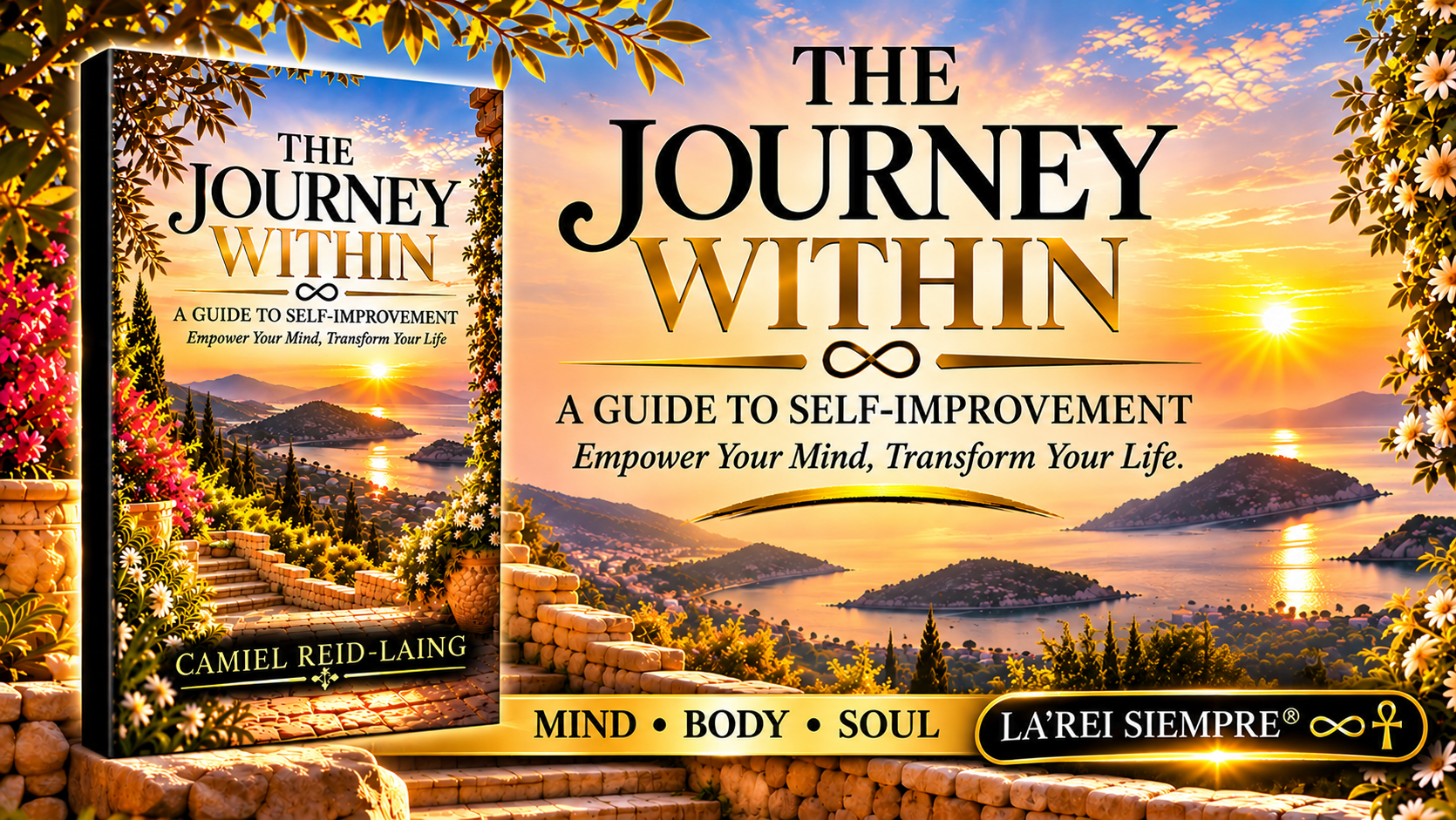
  • The Journey Within: Your Path to Self-Discovery and Personal Growth

    The Journey Within: Your Path to Self-Discovery and Personal Growth

    By LA’REI SIEMPRE® | Books & Personal Growth

    Every journey of transformation begins somewhere. Sometimes, the most important journey we will ever take is not towards a new destination, but towards a deeper understanding of ourselves.

    The Journey Within: A Guide to Self-Improvement — Empower Your Mind, Transform Your Life, written by Camiel Reid-Laing, invites readers to explore the relationship between self-awareness, mindset, personal responsibility and meaningful change.

    Understanding Yourself Is Where Growth Begins

    We often spend so much time responding to the world around us that we forget to examine what is happening within us.

    Our thoughts, beliefs, habits and experiences can influence the choices we make every day. Developing self-awareness allows us to recognise these patterns and consider whether they support the person we want to become.

    Personal growth is not about becoming somebody else. It is about understanding yourself more clearly and making choices that reflect your values and aspirations.

    Transformation Is a Journey, Not a Race

    Meaningful change rarely happens overnight.

    There will be moments of progress, periods of uncertainty and opportunities to reconsider old ways of thinking.

    What matters is our willingness to keep learning, reflecting and moving forward.

    You do not need to have every answer before you begin. Sometimes, the decision to understand yourself better is the first step towards lasting transformation.

    Your Journey Starts Within

    The Journey Within encourages readers to approach self-improvement with intention, reflection and a commitment to personal development.

    Whether you are beginning your self-discovery journey or seeking a fresh perspective on your personal growth, this book offers an opportunity to pause, look inward and consider what comes next.

    Your transformation begins with you.

    Explore The Journey Within

    Discover The Journey Within by Camiel Reid-Laing and begin your journey towards greater self-awareness and personal growth.

    Explore the book: https://lareisiempre.com/books/

    FAITH • HEALING • CREATING • PURPOSE

    lareisiempre.com
    — LA’REI SIEMPRE® ∞ ☥ 💜

  • I MADE MY LIFE LOOK BEAUTIFUL

    I MADE MY LIFE LOOK BEAUTIFUL

    Subscribe to continue reading

    Subscribe to get access to the rest of this post and other subscriber-only content.

  • 5 Areas of Self-Improvement That Can Change the Way You Live

    5 Areas of Self-Improvement That Can Change the Way You Live

    Self-improvement is often presented as a list of things we need to fix.

    Become more productive. Wake up earlier. Think positively. Exercise more. Set bigger goals. Develop better habits.

    Some of those things can certainly help, but meaningful self-improvement goes deeper than constantly searching for another part of yourself to correct.

    Sometimes the most important question is not:

    “What is wrong with me?”

    It is:

    “What area of my life needs my attention?”

    Growth requires awareness.

    We have to become willing to notice what is strengthening us, what is limiting us, what we have outgrown and what we may be continuing simply because it has become familiar.

    If you want to improve your life but do not know where to begin, these five areas can provide a useful starting point.

    They are not a formula for becoming perfect.

    They are invitations to pay attention.


    1. Faith — Strengthen the Foundation Beneath Your Growth

    Personal growth often focuses on what we can do for ourselves.

    And personal responsibility matters.

    We have decisions to make, habits to change, boundaries to establish and work to do.

    But for those of us whose lives are rooted in faith, self-improvement is not only about becoming more capable. It is also about becoming more grounded in our relationship with God.

    Faith gives us somewhere to return when life becomes uncertain.

    It reminds us that our worth is not determined entirely by achievement, productivity, approval or how quickly our lives appear to be progressing.

    There will be seasons when you have done everything you know how to do and still cannot control the outcome.

    That is where faith becomes more than something we say we have.

    It becomes something we practise.

    Prayer can create space to become still before reacting.

    Scripture can challenge the thoughts we have accepted as truth.

    Trust can help us continue when we cannot yet see how everything will unfold.

    And gratitude can remind us that even while we are working towards something more, there is still something to recognise in what we already have.

    The goal is not to use faith as an excuse to avoid action.

    Pray—and do the work that is yours to do.

    Trust God—and still make responsible decisions.

    Ask for direction—and remain willing to move when direction becomes clear.

    Faith and personal responsibility do not have to compete.

    They can work together.

    Reflection

    When life becomes uncertain, what is currently anchoring me?

    Consider whether your spiritual life receives attention only when something goes wrong, or whether you are intentionally strengthening it during ordinary seasons too.


    2. Mindset — Pay Attention to the Voice You Live With Every Day

    You spend an extraordinary amount of time listening to yourself.

    Not necessarily aloud—but internally.

    I can’t do that.

    I’m too old.

    I’m not ready.

    People like me don’t succeed at things like this.

    I’ll probably fail.

    There is no point trying.

    When thoughts are repeated often enough, they can begin to sound less like opinions and more like facts.

    That matters because the way you think can influence the way you behave.

    If you continually tell yourself that you are incapable, you may stop attempting things that could teach you otherwise.

    If you believe failure would prove something terrible about you, you may avoid situations where failure is possible.

    If you believe change is beyond you, remaining where you are can begin to feel safer than discovering what you are capable of becoming.

    Improving your mindset does not mean pretending everything is wonderful.

    It does not mean ignoring genuine problems or repeating positive statements you do not believe.

    It means learning to examine your thoughts instead of automatically obeying them.

    When a limiting thought appears, pause.

    Ask:

    Is this true?

    What evidence supports it?

    What evidence challenges it?

    Is this my belief—or something I learned from someone else?

    What would I do differently if I stopped treating this thought as a fact?

    Sometimes the thought will contain useful information.

    Sometimes it will reveal fear.

    Sometimes it will expose an old belief that no longer belongs in the life you are building.

    The goal is not to eliminate every negative thought.

    The goal is to stop giving every thought authority.

    Reflection

    What do I repeatedly tell myself that I would never say to someone I was trying to encourage?

    Write it down.

    Then ask whether that voice is helping you grow—or teaching you to remain small.


    3. Environment — Examine What Your Surroundings Are Reinforcing

    When people hear the word environment, they often think about their home or workplace.

    Those spaces matter.

    But your environment is bigger than the room you are sitting in.

    It can include:

    • the people you regularly interact with,
    • the conversations you repeatedly participate in,
    • the content you consume,
    • your digital spaces,
    • your routines,
    • your physical surroundings,
    • and the behaviours that have become normal around you.

    Your environment does not make every decision for you.

    But it can make certain behaviours easier to repeat.

    Imagine trying to become more focused while notifications interrupt you every few minutes.

    Imagine trying to develop confidence while spending most of your time in spaces where you are constantly criticised.

    Imagine trying to improve your relationship with yourself while consuming content that repeatedly makes you feel inadequate.

    Willpower matters.

    But sometimes growth becomes easier when we stop designing environments that require us to fight ourselves constantly.

    Look around your life.

    What is being reinforced?

    Distraction or concentration?

    Comparison or contentment?

    Growth or stagnation?

    Peace or constant stimulation?

    You may not be able to change every environment immediately.

    Workplaces, financial circumstances, family responsibilities and living situations can place genuine limits on what can be changed.

    But even within those realities, there may be smaller adjustments available.

    Turn off unnecessary notifications.

    Create one peaceful corner.

    Change what you consume online.

    Spend more time around conversations that encourage growth.

    Remove something from your immediate environment that repeatedly pulls you towards a habit you are trying to change.

    Small environmental changes can support larger internal ones.

    Reflection

    Does my current environment make the person I want to become easier or harder to practise being?

    Notice the word practise.

    Becoming is rarely one dramatic transformation.

    Much of it happens through what we repeatedly practise.


    4. Self-Awareness — Understand Who You Are Before Deciding Who You Want to Become

    It is difficult to intentionally change something you have never taken the time to understand.

    This is why self-awareness matters.

    Before asking:

    “Who do I want to become?”

    it can be useful to ask:

    “Who am I right now?”

    Not the version you present to other people.

    Not the version you think you should be.

    The person underneath all of that.

    What are your strengths?

    What repeatedly triggers you?

    What do you avoid?

    What brings you alive?

    What drains you?

    What patterns keep appearing in your relationships?

    What happens when you feel rejected, criticised, uncertain or afraid?

    What values do you claim to hold—and do your everyday decisions reflect them?

    Self-awareness requires honesty, but honesty does not require cruelty.

    You can recognise a weakness without deciding that you are weak.

    You can acknowledge a mistake without making the mistake your identity.

    You can recognise a pattern without condemning yourself for having developed it.

    The purpose of looking inward is not to collect evidence against yourself.

    It is to understand yourself well enough to make more intentional choices.

    Sometimes what we discover will affirm us.

    Sometimes it will challenge us.

    Both can be valuable.

    Because the moment you can recognise a pattern while it is happening, you have created something extremely important:

    a choice.

    You can continue automatically.

    Or you can respond differently.

    That is where awareness begins turning into growth.

    Reflection

    What have my repeated choices been teaching me about myself?

    Do not rush to judge the answer.

    Observe it first.

    There is information there.


    5. Boundaries — Protect the Growth You Are Working to Create

    Growth requires more than knowing what you want to build.

    Eventually, you also have to decide what you will no longer allow to repeatedly dismantle it.

    That is where boundaries become important.

    Boundaries are sometimes misunderstood as:

    “Cut everybody off.”

    😂 No.

    Healthy boundaries can take many forms.

    A boundary might mean saying no without writing a five-paragraph explanation.

    It might mean changing how much access someone has to you.

    It might mean refusing to participate in a conversation that repeatedly becomes disrespectful.

    It might mean protecting time you have committed to something important.

    It might mean changing a habit.

    It might mean leaving a situation that continually harms your wellbeing when leaving is realistically and safely possible.

    And sometimes a boundary is not about another person at all.

    You may need boundaries with your phone.

    Your spending.

    Your work.

    Your tendency to overcommit.

    Your need to rescue everybody.

    Your procrastination.

    Even your own habit of returning to situations you already know do not support the person you are trying to become.

    Boundaries are not punishment.

    They are information.

    They communicate:

    This is what I can participate in.

    This is what I cannot continue participating in.

    And boundaries are most effective when they are supported by your own behaviour.

    You cannot control whether another person agrees with your boundary.

    You can decide what you will do when it is crossed.

    That distinction matters.

    Reflection

    What am I repeatedly allowing that works against the life I say I want?

    Do not immediately ask who needs to leave your life.

    First ask what you may need to change.


    Self-Improvement Is Connected

    These five areas do not exist separately.

    They influence one another.

    Your mindset can affect the boundaries you believe you are allowed to set.

    Your environment can reinforce habits you are trying to change.

    Your self-awareness can reveal why certain situations keep repeating.

    Your boundaries can create space for healthier patterns to develop.

    And your faith can anchor you while change feels uncomfortable or uncertain.

    This is why meaningful self-improvement rarely comes from changing one surface-level behaviour and expecting everything else to fall into place.

    Human beings are more complex than that.

    Sometimes the habit is only the visible part.

    Underneath it may be a belief.

    Underneath the belief may be an experience.

    Around the experience may be an environment that continues reinforcing it.

    And somewhere in that process may be a version of you that learned how to survive but has never stopped to ask whether that way of living is still necessary.

    That is why the journey inward matters.


    Choose One Area and Begin There

    After reading an article about self-improvement, it can be tempting to create a list of seventeen things that must change immediately.

    Please don’t. 😂

    You do not need to renovate your entire existence by Tuesday.

    Instead, look again at the five areas:

    Faith.
    Mindset.
    Environment.
    Self-Awareness.
    Boundaries.

    Which one created the strongest reaction in you?

    Which one made you uncomfortable?

    Which one made you think:

    “I know I need to work on that.”

    Start there.

    Choose one realistic action.

    Maybe you spend ten intentional minutes in prayer each morning.

    Maybe you begin challenging one recurring limiting belief.

    Maybe you remove one distraction from your environment.

    Maybe you start journalling about a pattern you have finally recognised.

    Maybe you establish one boundary you have been avoiding.

    Then observe.

    Not for perfection.

    For information.

    What changes?

    What becomes difficult?

    What resistance appears?

    What do you learn about yourself?

    Self-improvement becomes much more useful when it stops being something we merely consume and becomes something we practise.


    The Journey Within

    These five areas are starting points.

    Real self-improvement requires something deeper than a checklist. It requires a willingness to look honestly at yourself, understand the patterns shaping your life and intentionally participate in who you are becoming.

    That deeper work is at the heart of my upcoming book:

    The Journey Within

    A Guide to Self-Improvement

    Empower Your Mind, Transform Your Life

    The book goes further into the work of understanding yourself, creating meaningful change and becoming more intentional about the life you are building.

    But you do not need to wait for a book to begin.

    Begin here.

    Choose one area.

    Ask yourself the difficult question.

    Take one honest step.

    Then another.

    Because self-improvement is not about waking up one morning as an entirely different person.

    It is about becoming increasingly conscious of the person you already are—and increasingly intentional about the person you are becoming.

    The journey may change your life.

    But first, you have to be willing to go within.

    — LA’REI SIEMPRE ∞ 💜

    lareisiempre.com

  • While You Were Watching Their Life, Who Was Building Yours?

    While You Were Watching Their Life, Who Was Building Yours?

    Sometimes we become so focused on what someone else has that we stop appreciating what God has already placed in our own hands.

    Their success.

    Their opportunities.

    Their relationships.

    Their confidence.

    Their purpose.

    Their life.

    And before long, admiration becomes comparison. Comparison becomes fixation. And fixation can become so consuming that instead of building our own lives, we spend our time watching someone else build theirs.

    But while you were watching their life, who was building yours?

    Comparison Can Distract You From Your Own Life

    There is nothing wrong with being inspired by another person.

    Sometimes seeing someone else succeed reminds us of what is possible.

    But inspiration should eventually lead you back to yourself.

    What can you create?

    What can you improve?

    What can you learn?

    What foundation are you building?

    The problem begins when your attention never returns home.

    When you become preoccupied with another person’s progress, you can easily lose sight of your own.

    You start measuring your beginning against their middle.

    You question why their opportunities haven’t happened for you.

    You wonder why their journey appears easier.

    And instead of investing that energy into developing yourself, you spend it analysing them.

    Meanwhile, your own life is waiting for your attention.

    You Cannot Build a Life Through Imitation

    There is a difference between learning from someone and trying to become them.

    You can study someone’s discipline.

    You can admire their creativity.

    You can learn from their decisions.

    You can even allow their journey to inspire your own.

    But eventually, you have to build something that belongs to you.

    Because copying the appearance of someone else’s life does not give you the foundation beneath it.

    You don’t know every sacrifice they made.

    You don’t know how long they worked when nobody was watching.

    You don’t know what they had to heal from, overcome, learn or surrender.

    You are seeing what was built.

    You may not have witnessed the building.

    And that distinction matters.

    What You Water Will Grow

    Attention is an investment.

    Where you consistently place your time, thoughts and energy matters.

    If most of your attention is directed towards another person’s life, there may be very little left for your own development.

    Imagine what could happen if that same energy came home.

    The hours spent comparing could become hours learning.

    The energy spent watching could become energy creating.

    The frustration could become discipline.

    The envy could become information.

    Instead of asking:

    “Why do they have it?”

    Ask:

    “What do I need to build?”

    That question changes everything.

    Because now your attention has returned to the only life you are responsible for developing:

    your own.

    Someone Else’s Purpose Does Not Cancel Yours

    I believe God created each of us with our own gifts, experiences, lessons and purpose.

    That means another person’s blessing is not evidence that you have been forgotten.

    Their opportunity does not remove yours.

    Their growth does not diminish your potential.

    Their light does not require your darkness.

    There is room for you to become everything God created you to become.

    But you cannot discover that person while constantly trying to become somebody else.

    Scripture says:

    “But let every man prove his own work, and then shall he have rejoicing in himself alone, and not in another.”
    — Galatians 6:4 (KJV)

    There is wisdom in bringing our attention back to our own work.

    Our own character.

    Our own healing.

    Our own discipline.

    Our own relationship with God.

    Our own foundation.

    Build the Foundation

    A beautiful life needs more than an appearance.

    It needs a foundation.

    Before the business comes the knowledge.

    Before the confidence comes the inner work.

    Before the healthy relationship comes the healing.

    Before financial stability comes discipline.

    Before purpose becomes visible, there are often years of preparation that nobody sees.

    Foundations are rarely glamorous.

    Nobody applauds every brick.

    But when life becomes difficult, the foundation is what determines whether what you built can stand.

    That is why you cannot afford to spend your building years watching somebody else’s building.

    There is work waiting for you at home.

    Turn Comparison Into Information

    If someone’s life triggers something inside you, you don’t always have to run from the feeling.

    Study it.

    Maybe their confidence reveals an area where you want to grow.

    Maybe their success reminds you of a dream you abandoned.

    Maybe their discipline exposes where you’ve been procrastinating.

    Maybe seeing someone live boldly reminds you that you’ve been making yourself small.

    You don’t have to resent the person who revealed the desire.

    Use the information.

    Ask yourself:

    What is this showing me about what I want to develop within my own life?

    Then get to work.

    That is how comparison can become self-awareness instead of self-destruction.

    Come Back to Your Own Life

    At some point, you have to stop looking sideways.

    Come back to your gifts.

    Come back to your ideas.

    Come back to your healing.

    Come back to your relationship with God.

    Come back to the dreams you’ve been postponing.

    Come back to the person you are becoming.

    You were given a life of your own.

    Build it.

    Not as a replica of somebody else’s.

    Not as a competition.

    Not to prove that you are better.

    Build it because your life deserves your participation.

    Build it because your gifts deserve development.

    Build it because your purpose requires preparation.

    And build it because while you are busy watching what somebody else is becoming, you may be neglecting everything you were created to become.

    Stop watching their foundation.

    Start laying your own bricks.

    No foundation. No growth.

    Build your own life.

    — LA’REI SIEMPRE ∞ 💜

  • The Ten Commandments: What They Mean and Why They Still Matter Today

    The Ten Commandments: What They Mean and Why They Still Matter Today

    The Ten Commandments are among the most recognised teachings in the Bible, yet their meaning reaches far beyond a list of rules. Given by God to the children of Israel through Moses, they provide guidance for our relationship with God, our relationship with others, and the way we choose to live.

    Thousands of years later, these commandments still speak to many of the challenges we face today — from what we place at the centre of our lives to how we treat others, honour our commitments, manage our desires, and walk with integrity.

    In this article, we will explore each of the Ten Commandments, what the Scripture says, what it means, and how its wisdom can be applied to everyday life.

    1. Thou Shalt Have No Other Gods Before Me

    “Thou shalt have no other gods before me.”
    — Exodus 20:3 (KJV)

    What it means:
    God calls us to place Him above everything else. While the ancient world worshipped many physical gods and idols, modern “gods” can look very different. Money, status, relationships, possessions, success — even our own desires — can take a place in our lives that belongs to God.

    How it applies today:
    This commandment invites us to examine our priorities. What receives our greatest devotion, trust and attention? There is nothing wrong with pursuing goals, building a successful life or loving the people around us, but none of these things should become the foundation of our identity or take God’s place at the centre of our lives.

    2. Thou Shalt Not Make Unto Thee Any Graven Image

    “Thou shalt not make unto thee any graven image, or any likeness of any thing that is in heaven above, or that is in the earth beneath, or that is in the water under the earth:”
    — Exodus 20:4 (KJV)

    What it means:
    This commandment warns against creating images or objects and treating them as gods or giving them the worship that belongs to God. The issue is not simply the existence of an image or object, but allowing something created to become an object of worship.

    How it applies today:
    Idolatry does not always look like a carved statue. Anything we elevate to a place of ultimate devotion, dependence or worship can become an idol. This commandment encourages us to consider where we place our deepest trust and to ensure that our worship remains directed toward God rather than the things we create, possess or admire.

    3. Thou Shalt Not Take the Name of the LORD Thy God in Vain

    “Thou shalt not take the name of the LORD thy God in vain; for the LORD will not hold him guiltless that taketh his name in vain.”
    — Exodus 20:7 (KJV)

    What it means:
    God’s name is sacred and should be treated with reverence. This commandment teaches us not to use His name carelessly, dishonestly or disrespectfully. Honouring God includes honouring His name in both our words and our actions.

    How it applies today:
    This goes beyond avoiding certain expressions. It invites us to consider how we represent God in everyday life. We should be careful not to use His name to manipulate others, justify harmful behaviour, make dishonest promises, or claim that God said something simply to give our own opinions greater authority. If we speak in God’s name, our words and conduct should reflect reverence, truth and integrity.

    4. Remember the Sabbath Day, to Keep It Holy

    “Remember the sabbath day, to keep it holy.”
    — Exodus 20:8 (KJV)

    What it means:
    The Sabbath was established as a sacred time set apart for rest and devotion to God. After six days of work, God commanded His people to stop, remember Him, and keep the seventh day holy. It reminds us that life was never intended to be an endless cycle of work and productivity.

    How it applies today:
    In a culture that often celebrates being constantly busy, this commandment reminds us of the importance of making intentional space for God and for rest. Sabbath observance is understood differently across Christian traditions, but the principle challenges us to examine whether our lives leave room to worship, pause, restore ourselves, and remember that our worth is not measured solely by how much we accomplish.

    5. Honour Thy Father and Thy Mother

    “Honour thy father and thy mother: that thy days may be long upon the land which the LORD thy God giveth thee.”
    — Exodus 20:12 (KJV)

    What it means:
    This commandment teaches us to treat our parents with honour and respect, recognising the responsibility and position God gave them within the family. Honour can include gratitude, consideration, care and appropriate respect throughout different stages of life.

    How it applies today:
    Honouring a parent does not mean approving of everything they do, tolerating harmful behaviour, or abandoning healthy boundaries. Family relationships can be complicated, and respect does not require us to remain in situations that cause harm. We can seek to act with integrity, avoid unnecessary cruelty or bitterness, and extend honour where appropriate while still protecting our wellbeing and maintaining necessary boundaries.

    6. Thou Shalt Not Kill

    “Thou shalt not kill.”
    — Exodus 20:13 (KJV)

    What it means:
    This commandment affirms the sacred value of human life and prohibits the unlawful taking of life. It reminds us that life is precious and that we have a responsibility to recognise the dignity and humanity of others.

    How it applies today:
    Most people may never physically take another person’s life, but this commandment also invites deeper reflection on how we regard and treat human beings. Jesus later taught that anger, contempt and unresolved hostility matter spiritually too. Choosing peace, exercising self-control, resolving conflict wisely, and refusing to dehumanise others are ways we can honour the value of life in our everyday relationships.

    7. Thou Shalt Not Commit Adultery

    “Thou shalt not commit adultery.”
    — Exodus 20:14 (KJV)

    What it means:
    This commandment protects the sacred commitment of marriage and calls for faithfulness between spouses. Adultery breaks trust, violates the promises made within marriage, and can cause deep emotional and relational harm.

    How it applies today:
    Faithfulness involves more than avoiding a physical affair. It also asks us to consider the boundaries, honesty and emotional loyalty we bring into committed relationships. Secrecy, inappropriate emotional attachments and behaviours that betray agreed boundaries can damage trust even before physical infidelity occurs. Healthy relationships require honesty, respect, communication and a willingness to protect the commitment we have made to another person.

    8. Thou Shalt Not Steal

    “Thou shalt not steal.”
    — Exodus 20:15 (KJV)

    What it means:
    This commandment teaches respect for what belongs to others. Taking something that is not ours violates trust, disregards another person’s rights, and places our own desires above honesty and integrity.

    How it applies today:
    Stealing is not limited to taking physical possessions. It can include dishonesty involving money, knowingly taking credit for someone else’s work, using another person’s property without permission, or benefiting from something we know is not rightfully ours. This commandment challenges us to live with integrity even when no one is watching and to obtain what we need or desire through honest means.

    9. Thou Shalt Not Bear False Witness Against Thy Neighbour

    “Thou shalt not bear false witness against thy neighbour.”
    — Exodus 20:16 (KJV)

    What it means:

    This commandment forbids giving false testimony against another person. At its heart, it calls us to truthfulness and warns against using lies or deception to damage someone else’s character, reputation or circumstances.

    How it applies today:
    False witness can appear through lies, false accusations, deliberately misleading others, spreading rumours as though they are facts, or repeating information we have not verified. In a world where words can travel instantly through social media, the consequences can be especially damaging. This commandment reminds us to speak truthfully, resist participating in gossip or character assassination, and be careful that our words do not unjustly harm another person.

    10. Thou Shalt Not Covet

    “Thou shalt not covet thy neighbour’s house, thou shalt not covet thy neighbour’s wife, nor his manservant, nor his maidservant, nor his ox, nor his ass, nor any thing that is thy neighbour’s.”
    — Exodus 20:17 (KJV)

    What it means:
    To covet is to intensely desire what belongs to someone else. Unlike commandments that focus primarily on outward actions, this one turns our attention inward — to our thoughts, desires and attitudes. It warns against allowing envy and dissatisfaction to take root in our hearts.

    How it applies today:
    Comparison can make it easy to focus on another person’s relationship, home, career, possessions, success or lifestyle and begin believing that what they have should be ours. Social media can intensify this by constantly showing us carefully selected glimpses of other people’s lives. This commandment encourages gratitude, contentment and trust in our own journey. We can celebrate what others have without allowing their blessings to make us resent our own lives or lose sight of what God has already placed in our hands.

    The Ten Commandments Still Speak Today

    The Ten Commandments were given thousands of years ago, but the principles behind them continue to challenge the way we live, love, speak, work and relate to God and one another.

    They call us to examine not only our actions, but also our priorities, our words, our relationships, our integrity and even the desires of our hearts.

    Living by these principles does not mean we will never make mistakes. We are human, and growth often involves recognising where we have fallen short, seeking forgiveness, making different choices and continuing forward with greater wisdom.

    Perhaps the Ten Commandments are not simply a list to memorise, but an invitation to reflect:

    What has first place in my life?
    Do my words reflect truth and integrity?
    Do I honour my commitments?
    Am I respecting what belongs to others?
    Can I celebrate another person’s blessings without becoming dissatisfied with my own?

    God’s guidance is not meant merely to be read. It is meant to shape how we live.

    “If ye love me, keep my commandments.”
    — John 14:15 (KJV)

    — LA’REI SIEMPRE ∞ 💜

  • When Self-Love Requires You to Keep Going Without Them

    When Self-Love Requires You to Keep Going Without Them

    You know, if you don’t have self-love, rejection can make you falter.

    When people reject you, abandon you, refuse to help you, misunderstand you, or suddenly change how they treat you, it can make you question yourself.

    You may begin wondering what you did wrong.

    You may question the path you’re on.

    You may even be tempted to make yourself smaller just to keep certain people comfortable.

    But this is where self-love becomes important.

    Because sometimes, continuing to become who God called you to be means accepting that everyone cannot continue the journey with you.

    Not Every Battle Is Yours to Fight

    People can sit with you, laugh with you, encourage you and appear to support you — and still struggle when you begin changing, growing or establishing boundaries.

    That can hurt.

    Especially when it comes from someone you never expected.

    But another person’s reaction to your growth does not automatically mean your growth is wrong.

    Sometimes the healthiest thing you can do is stop fighting to be understood.

    You don’t have to argue your way into someone’s acceptance.

    You don’t have to convince everyone that your intentions are good.

    And you certainly don’t have to abandon yourself simply because someone else has decided to walk away.

    Self-Love Requires Boundaries

    People will sometimes test your boundaries.

    Someone may walk away expecting you to chase them.

    They may withdraw and expect you to abandon your boundary to restore the relationship.

    And they may even become upset when you finally allow them to go.

    But a boundary means very little if you remove it every time someone becomes uncomfortable with it.

    Self-love teaches you that you can care about someone and still say no.

    You can love someone and still choose distance.

    You can forgive someone without giving them unlimited access to you.

    And you can let someone go without hating them.

    That isn’t cruelty.

    Sometimes, that is growth.

    Rejection Does Not Cancel Your Purpose

    One of the most important things I have learned is this:

    Nobody on this earth has the power to control who you are or what you are here to do.

    People can refuse to support you.

    They can misunderstand you.

    They can talk about you.

    They can reject you.

    They can decide they no longer want to walk beside you.

    But they cannot determine your purpose.

    If you believe God has placed something in your heart and called you toward a particular path, another person’s rejection does not automatically mean you should stop walking.

    There will be times when you have to continue without the people you thought would be beside you.

    That is when your faith cannot depend solely upon human approval.

    God Has the Final Say

    People may have opinions about your life.

    But opinions are not authority over your destiny.

    There will always be things happening around you that you cannot control. There may be conflict you don’t understand, conversations you aren’t part of, and decisions people make without your knowledge.

    You don’t need to know everything.

    You don’t need to investigate everything.

    You don’t need to respond to everything.

    Sometimes you simply have to keep your heart clean, protect your peace and trust God with what you cannot see.

    As Scripture reminds us:

    “What shall we then say to these things? If God be for us, who can be against us?”
    — Romans 8:31 (KJV)

    That doesn’t mean we will never face opposition.

    It means opposition does not get the final word.

    God does.

    Keep Walking

    Self-love isn’t believing you’re better than anyone else.

    It is learning that you don’t have to destroy yourself to prove that you love someone.

    It is recognising when something is costing you your peace.

    It is trusting yourself enough to maintain healthy boundaries.

    And it is having enough faith to continue walking when someone you expected to accompany you chooses another direction.

    Not everybody is meant to follow you into every chapter.

    Some people will leave.

    Some relationships will change.

    Some doors will close.

    Let them.

    Wish people well.

    Don’t seek revenge.

    Don’t allow bitterness to take root in your heart.

    And don’t spend your life looking backwards at who decided not to come with you.

    Choose yourself without hatred.

    Let go without revenge.

    Keep your heart clean.

    Trust God.

    And keep walking.

    Because what God has ordained for your life does not require you to abandon yourself in order to receive it.

    — LA’REI SIEMPRE ∞ 💜

  • Finding God in the Simple Things: The Ladybird at My Favourite Tree

    Finding God in the Simple Things: The Ladybird at My Favourite Tree

    I went to one of my favourite places — my favourite tree — and there, quietly resting on the bark, was a tiny ladybird.

    She was so small that I could easily have missed her.

    But I didn’t.

    I stopped.

    I looked.

    And for a moment, everything else seemed to become quiet.

    Red ladybird resting on the textured bark of my favourite tree.

    A Little Moment of Peace

    There is something about nature that reminds me to slow down.

    Life can become so busy that we begin moving from one responsibility to another without noticing the beauty that surrounds us. Yet sometimes, all it takes is one small moment to bring us back to the present.

    For me, on this occasion, it was a little red ladybird waiting on the bark of a tree I already loved.

    It wasn’t something spectacular by the world’s standards.

    But it made me smile.

    And it reminded me that joy doesn’t always arrive loudly.

    Sometimes, it is found in the smallest things.

    God Is in the Simple Things

    As I stood there looking at her, I thought about how easy it is to search for God only in the extraordinary.

    We look for the big breakthrough.

    The unmistakable sign.

    The answered prayer.

    The miracle we cannot explain.

    But God’s handiwork surrounds us every day.

    “The heavens declare the glory of God; and the firmament sheweth his handywork.”
    — Psalm 19:1 KJV

    Creation itself gives us reasons to pause.

    The trees.

    The sky.

    The changing seasons.

    The birds.

    And yes — even one tiny ladybird resting quietly on the bark of a favourite tree.

    Don’t Miss the Small Blessings

    That little encounter reminded me that not every meaningful moment needs to change the course of your life.

    Some moments simply come to brighten your day.

    Some remind you to breathe.

    Some bring you peace.

    And some gently remind you that there is still beauty around you, even when life feels heavy.

    Had I been rushing, I might never have noticed her.

    And that made me wonder:

    How many beautiful little moments do we miss because we’re moving too quickly?

    Today, take a moment to notice what is around you.

    Look at the sky.

    Notice the trees.

    Listen to the birds.

    Pay attention to the tiny things you would normally walk past.

    You never know what small piece of God’s creation might be waiting to remind you that beauty, peace and wonder are still here.

    Sometimes, you don’t have to look very far.

    Sometimes, you simply have to slow down enough to notice.

    — LA’REI SIEMPRE ∞ 💜


  • Introducing the LA’REI SIEMPRE Signature Mug Collection

    Introducing the LA’REI SIEMPRE Signature Mug Collection

    There is something special about seeing an idea that once lived only in your mind become something you can actually hold in your hands.

    The LA’REI SIEMPRE Signature Mug Collection represents exactly that for me.

    What began as a vision has slowly grown into a brand centred around four words that have become part of everything I create:

    Faith. Healing. Creating. Purpose.

    These aren’t simply words printed on a mug. They represent a journey.

    More Than a Mug

    I wanted the first LA’REI SIEMPRE merchandise collection to feel meaningful.

    Something you could reach for during your quiet morning with God.

    Something that could sit beside your journal while you write.

    Something you could use while working, reflecting, praying, planning your next chapter—or simply enjoying a peaceful cup of tea or coffee.

    Because sometimes the smallest parts of our daily routines become reminders of the life we are intentionally creating.

    And that is where the Signature Mug Collection began.

    Three Signature Designs

    The collection launches with three distinctive LA’REI SIEMPRE designs, each carrying the signature ankh and infinity emblem.

    LA’REI SIEMPRE Black and Gold Signature Mug featuring the gold ankh and infinity emblem on a black background.

    The Black & Gold Signature Mug

    Bold, elegant and unmistakably LA’REI SIEMPRE. The black background allows the gold emblem to take centre stage and gives this design its luxurious feel.

    LA’REI SIEMPRE Black Transparent Signature Mug featuring the black ankh and infinity emblem on a white ceramic mug.

    The Classic Black Signature Mug

    Clean, timeless and minimal. The black emblem against the white ceramic creates a simple design that works beautifully in any space.

    LA’REI SIEMPRE Gold Transparent Signature Mug featuring the gold ankh and infinity emblem on a white ceramic mug.

    The Gold Signature Mug

    Warm, refined and elegant. The gold emblem gives this version a softer luxury while still carrying the identity of the collection.

    And on the reverse:

    LA’REI SIEMPRE Signature Mug featuring the four brand pillars: Faith, Healing, Creating and Purpose.

    Faith.
    Healing.
    Creating.
    Purpose.

    Four words. One message.

    Faith. Healing. Creating. Purpose.

    Faith reminds us to trust God even when we cannot yet see where the road is leading.

    Healing reminds us that what hurt us does not have to define the rest of our lives.

    Creating reminds us that we can take what we have learned, experienced and overcome and use it to build something new.

    And Purpose reminds us that our lives have meaning—and sometimes the very experiences we thought would destroy us become part of what prepares us for where we are going.

    That philosophy sits at the heart of LA’REI SIEMPRE.

    The Beginning of Something Bigger

    These mugs may be the beginning of the merchandise collection, but the vision extends much further.

    I am building LA’REI SIEMPRE slowly and intentionally—one creation at a time.

    Every product should have a reason for existing.

    Every design should belong.

    And every piece should carry something of the message behind this brand.

    So seeing these first three designs come together feels like another small milestone on a much bigger journey.

    The LA’REI SIEMPRE Signature Mug Collection is now available through my Etsy shop.

    Choose the design that speaks to you, make it part of your daily ritual, or gift one to someone who could use a simple reminder to keep believing, healing, creating and walking in their purpose.

    Shop the LA’REI SIEMPRE Signature Mug Collection on Etsy.

    And wherever you are in your own journey today, remember:

    Keep the faith.
    Give yourself permission to heal.
    Keep creating.
    And never stop walking towards your purpose.

    — LA’REI SIEMPRE ∞ 💜